At the beginning of this summer, with no fanfare and little publicity, Redmond, Wash.-based Microsoft hauled its shipping container-sized underwater data center, consisting of 864 servers at a depth of 117 feet, from the seabed off the coast of the Orkney Islands to the northeast of Scotland.
Monday, 28 September 2020
Microsoft's Underwater Data Center Makes Environmental Strides
Tuesday, 22 September 2020
Edge computing: The next generation of innovation
Like other hot new areas of enterprise tech, edge computing is a broad architectural concept rather than a specific set of solutions. Primarily, edge computing is applied to low-latency situations where compute power must be close to the action, whether that activity is industrial IoT robots flinging widgets or sensors continuously taking the temperature of vaccines in production. The research firm Frost & Sullivan predicts that by 2022, 90 percent of industrial enterprises will employ edge computing.
Edge computing is a form of distributed computing that extends beyond the data center mothership. When you think about it, how else should enterprises invest in the future? Yes, we know that a big chunk of that investment will go to the big public cloud providers – but hardware and software that enterprises own and operate isn’t going away. So why not physically distribute it where the business needs it most?
Augmenting the operational systems of a company’s business on location – where manufacturing or healthcare or logistical operations reside – using the awesome power of modern servers can deliver all kinds of business value. Typically, edge computing nodes collect gobs of data from instrumented operational systems, process it, and send only the results to the mothership, vastly reducing data transmission costs. Embedded in those results are opportunities for process improvement, supply chain optimization, predictive analytics, and more.
CIO, Computerworld, CSO, InfoWorld, and Network World have joined forces to examine edge computing from five different perspectives. These articles help demonstrate that this emerging, complex area is attracting some of the most intriguing new thinking and technology development today.
The many sides of the edge
Edge computing may be relatively new on the scene, but it’s already having a transformational impact. In “4 essential edge-computing use cases,” Network World’s Ann Bednarz unpacks four examples that highlight the immediate, practical benefits of edge computing, beginning with an activity about as old-school as it gets: freight train inspection. Automation via digital cameras and onsite image processing not only vastly reduces inspection time and cost, but also helps improve safety by enabling problems to be identified faster. Bednarz goes on to pinpoint edge computing benefits in the hotel, retail, and mining industries.
CIO contributing editor Stacy Collett trains her sights on the gulf between IT and those in OT (operational technology) who concern themselves with core, industry-specific systems – and how best to bridge that gap. Her article “Edge computing’s epic turf war” illustrates that improving communication between IT and OT, and in some cases forming hybrid IT/OT groups, can eliminate redundancies and spark creative new initiatives.
One frequent objection on the OT side of the house is that IoT and edge computing expose industrial systems to unprecedented risk of malicious attack. CSO contributing writer Bob Violino addresses that problem in “Securing the edge: 5 best practices.” One key recommendation is to implement zero trust security, which mandates persistent authentication and micro-segmentation, so a successful attack in one part of an organization can be isolated rather than spreading to critical systems.
Computerworld contributing writer Keith Shaw examines the role of 5G in “Edge computing and 5G give business apps a boost.” One of 5G’s big selling points is its low latency, a useful attribute for connecting IoT devices. But as IDC research director Dave McCarthy explains in the article, the reduction in latency won’t help you when you’re connecting to a far-flung data center. On the other hand, if you deploy “edge computing into the 5G network, it minimizes this physical distance, greatly improving response times,” he says.
In case you’re wondering, the hyperscale cloud providers aren’t taking this edge stuff lying down. In “Amazon, Google, and Microsoft take their clouds to the edge,” InfoWorld contributing editor Isaac Sacolick digs into the early-stage edge computing offerings now available from the big three, including mini-clouds deployed in various localities as well as their exiting on-prem offerings (such as AWS Outposts or Azure Stack) that are fully managed by the provider. Sacolick writes that “the unique benefit public cloud edge computing offers is the ability to extend underlying cloud architecture and services.”
The crazy variety of edge computing offerings and use cases covers such a wide range, it begins to sound like, well, computing. As many have noted, the “big cloud” model is reminiscent of the old mainframe days, when customers tapped into centralized compute and storage through terminals rather than browsers. Edge computing recognizes that not everything can or should be centralized. And the inventive variations on that simple notion are playing a key role in shaping the next generation of computing.
https://www.networkworld.com/
Sunday, 30 August 2020
Open standards vs. open source: A basic explanation
What are open standards, exactly? You’ve probably heard the term thrown around, but why does it matter to your business? How does it relate to open source? What’s the difference?
Take a common example. Have you ever noticed that Wi-Fi seems to work the same with any router, phone or computer? We tend to take these types of standards for granted, but they bring huge benefits to our daily lives.
Imagine if there were no standards like Wi-Fi. Every business might have its own form of wireless technology. If your favorite coffee shop had a router made by Company X, and you owned a computer made by Company Y, you might have to find another coffee shop to check your email.
Even if each business had a functioning form of wireless internet, a lack of standards would make interoperability nearly impossible. Customers of every company would suffer.
Have you ever wondered how competing businesses all across the world somehow converge on one format for these things?
The answer is often open standards.
What are open standards?
An open standard is a standard that is freely available for adoption, implementation and updates. A few famous examples of open standards are XML, SQL and HTML.
Businesses within an industry share open standards because this allows them to bring huge value to both themselves and to customers. Standards are often jointly managed by a foundation of stakeholders. There are typically rules about what kind of adjustments or updates users can make, to ensure that the standard maintains interoperability and quality.
What is open source?
What is open source, then? The term may sound similar to open standards; but, in reality, it is fundamentally different.
At its core, open source code is created to be freely available, and most licenses allow for the redistribution and modification of the code by anyone, anywhere, with attribution. In many cases the license further dictates that any updates from contributors will also become free and open to the community. This allows a decentralized community of developers to collaborate on a project and jointly benefit from the resulting software.
How open standards and open source help prevent vendor lock-in
Both open source and open standards can help protect clients from vendor lock-in, but they do it in different ways.
Let’s start with an example of an open standard. A business might buy a PDF reader and editor from a vendor. Over time, the team could create a huge number of PDF documents. Maybe these documents become a valuable asset for the company. Since the PDF format is an open standard, the business would have no problem switching from one PDF software to another. There is no concern that it would be unable to access its documents. Even if the PDF reader software isn’t open source, the PDF format is an open standard. Everyone uses this format.
Now, let’s instead take a look at the benefits of open source. Imagine that a business had spent millions of dollars writing internal software code for a proprietary operating system. That business would no longer have the option of changing vendors. It would be stuck with that operating system, unless it wanted to make a significant investment re-writing that code to run on a different system.
Open source software could have prevented that issue. Because open source software does not belong to any particular business, clients are not locked-in to any particular provider.
In both of these examples, the client would be able to avoid vendor lock-in. In one case this is because a piece of closed software followed a common open standard. In the other case, it is because the software itself belonged to an open source community.
While these are fundamentally different things, both help foster innovation while also providing more options to customers.
https://www.ibm.com/
Friday, 21 August 2020
Importance of Software Engineering
Software engineering is the study of and practice of engineering to build, design, develop, maintain, and retire software. There are different areas of software engineering and it serves many functions throughout the application lifecycle. Effective software engineering requires software engineers to be educated about good software engineering best practices, disciplined and cognizant of how your company develops software, the operation it will fulfill, and how it will be maintained.
Software engineering is a new era as CIOs and Digital Leaders now understand the importance of software engineering and the impact – both good and bad – it can have on your bottom line.
Vendors, IT staff, and even departments outside of IT need to be aware that software engineering is increasing in its impact – it is affecting almost all aspects of your daily business.
The Importance of Software Engineers
Thursday, 20 August 2020
How Natural Language Processing Is Changing Data Analytics
Natural language processing (NLP) is the process by which computers understand and process natural human language. If you use Google Search, Alex, Siri, or Google Assistant, you’ve already seen it at work. The advantage of NLP is that it allows users to make queries without first having to translate them into “computer-speak.”
NLP has the potential to make both business and consumer applications easier to use. Software developers are already incorporating it in more applications than ever, including machine translation, speech recognition, sentiment analysis, chatbots, market intelligence, text classification, and spell checking.
This technology can be especially useful within data analytics, which analyzes data to help business leaders, researchers, and others gain insights that assist them in making effective decisions. As we’ll see below, NLP can support data analytics efforts in multiple ways, such as solving major global problems and helping more people, even those not trained in data processing, use these systems.
Managing Big Data
With the help of NLP, users can analyze more data than ever, including for critical processes like medical research. This technology is especially important now, as researchers attempt to find a vaccine for COVID-19.
In a recent article, the World Economic Forum (WEF) points out that NLP can help researchers tackle COVID-19 by going through vast amounts of data that would be impossible for humans to analyze. “Machines can find, evaluate, and summarise the tens of thousands of research papers on the new coronavirus, to which thousands are added every week….” In addition, this technology can help track the spread of the virus by detecting new outbreaks.
According to the WEF article, NLP can aid the research process when data analysts “[train] machines to analyze a user question in a full sentence, then to read the tens of thousands of scholarly articles in the database, rank them and generate answer snippets and summaries.” For example, a researcher may use the question, “Is COVID-19 seasonal?” and the system reviews the data and returns relevant responses.
Solving Problems
In addition to pressing health problems, NLP used in conjunction with artificial intelligence (AI) can help professionals solve other global challenges, such as clean energy, global hunger, improving education, and natural disasters. For example, according to a Council Post appearing on Forbes, “Huge companies like Google are setting their sights on flood prevention, utilizing AI to predetermine areas of risk and notify people in impacted areas.”
Enabling More Professionals
According to an InformationWeek article, “With natural language search capabilities, users don’t have to understand SQL or Boolean search, so the act of searching is easier.” As the quality of insights depends on knowing how to “ask the right questions,” this skill may soon become essential for business operators, managers, and administrative staff.
For example, anyone within a company could use NLP to query a BI system with a question like, “What was the inventory turnover rate last fiscal year compared to this fiscal year?” The system would convert each phrase to numeric information, search for the needed data, and return it in natural language format. Such queries allow any employee in any department to gain critical insights to help them make informed decisions.
Creating a Data-Driven Culture
In the past, business intelligence (BI) powered by data analytics required trained data professionals to correctly input queries and understand results. But NLP is changing that dynamic, resulting in what some experts are calling “data democratization”: the ability for more people to have access to data sets formerly reserved only for those with the advanced skills needed to interpret it.
The more people within a company who know how to gather insights based on data, the more that company can benefit from a data-driven culture, which is one that relies on hard evidence rather than guesswork, observation, or theories to make decisions. Such a culture can be nurtured in any industry, including healthcare, manufacturing, finance, retail, or logistics.
For example, a retail marketing manager might want to determine the demographics of customers who spend the most per purchase and target those customers with special offers or loyalty rewards. A manufacturing shift leader might want to test different methods within its operations to determine which one yields the greatest efficiency. With NLP, the commands needed to get this information can be executed by anyone in the business.
In Summary
NLP is not yet widespread. According to the InformationWeek article, “A few BI and analytics vendors are offering NLP capabilities but they're in the minority for now. More will likely enter the market soon to stay competitive.”
As it becomes more prevalent, NLP will enable humans to interact with computers in ways not possible before. This new type of collaboration will allow improvements in a wide variety of human endeavors, including business, philanthropy, health, and communication.
These advancements will become even more useful as computers learn to recognize context and even nonverbal human cues like body language and facial expressions. In other words, conversations with computers are likely to continue becoming more and more human.
https://www.kdnuggets.com/2020/08/natural-language-processing-changing-data-analytics.html
Monday, 10 August 2020
Software Architecture Guide
What is architecture?
People in the software world have long argued about a definition of architecture. For some it's something like the fundamental organization of a system, or the way the highest level components are wired together. My thinking on this was shaped by an email exchange with Ralph Johnson, who questioned this phrasing, arguing that there was no objective way to define what was fundamental, or high level and that a better view of architecture was the shared understanding that the expert developers have of the system design.
A second common style of definition for architecture is that it's “the design decisions that need to be made early in a project”, but Ralph complained about this too, saying that it was more like the decisions you wish you could get right early in a project.
His conclusion was that “Architecture is about the important stuff. Whatever that is”. On first blush, that sounds trite, but I find it carries a lot of richness. It means that the heart of thinking architecturally about software is to decide what is important, (i.e. what is architectural), and then expend energy on keeping those architectural elements in good condition. For a developer to become an architect, they need to be able to recognize what elements are important, recognizing what elements are likely to result in serious problems should they not be controlled.
Why does architecture matter?
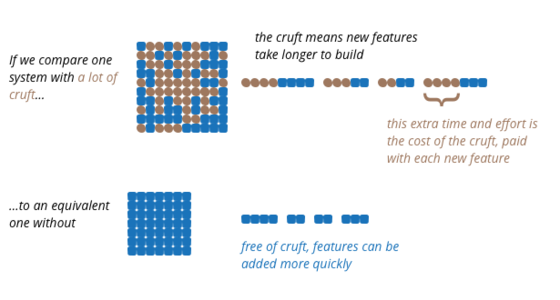
Architecture is a tricky subject for the customers and users of software products - as it isn't something they immediately perceive. But a poor architecture is a major contributor to the growth of cruft - elements of the software that impede the ability of developers to understand the software. Software that contains a lot of cruft is much harder to modify, leading to features that arrive more slowly and with more defects.

This situation is counter to our usual experience. We are used to something that is "high quality" as something that costs more. For some aspects of software, such as the user-experience, this can be true. But when it comes to the architecture, and other aspects of internal quality, this relationship is reversed. High internal quality leads to faster delivery of new features, because there is less cruft to get in the way.
While it is true that we can sacrifice quality for faster delivery in the short term, before the build up of cruft has an impact, people underestimate how quickly the cruft leads to an overall slower delivery. While this isn't something that can be objectively measured, experienced developers reckon that attention to internal quality pays off in weeks not months.
Monday, 27 July 2020
How to protect algorithms as intellectual property
“I doubt it is patent material, but it does give us a competitive edge and reduces our time-to-market significantly,” says Aguiar, chief innovation and transformation officer. “I look at algorithms as modern software modules. If they manage proprietary work, they should be protected as such.”
Intellectual property theft has become a top concern of global enterprises. As of February 2020, the FBI had about 1,000 investigations involving China alone for attempted theft of US-based technology spanning just about every industry. It’s not just nation-states who look to steal IP; competitors, employees and partners are often culprits, too.
Security teams routinely take steps to protect intellectual property like software, engineering designs, and marketing plans. But how do you protect IP when it's an algorithm and not a document or database? Proprietary analytics are becoming an important differentiator as companies implement digital transformation projects. Luckily, laws are changing to include algorithms among the IP that can be legally protected.
Patent and classify algorithms as trade secrets
For years, in-house counsel rightly insisted that companies couldn’t patent an algorithm. Traditional algorithms simply told a computer what to do, but AI and machine learning require a set of algorithms that enable software to update and “learn” from previous outcomes without the need for a programmer intervention, which can produce competitive advantage.
“People are getting more savvy about what they want to protect,” and guidelines have changed to accommodate them, says Mary Hildebrand, chair and founder of the privacy and cybersecurity practice at Lowenstein Sandler. “The US Patent Office issued some new guidelines and made it far more feasible to patent an algorithm and the steps that are reflected in the algorithm.”
Patents have a few downsides and tradeoffs. “If you just protect an algorithm, it doesn’t stop a competitor from figuring out another algorithm that takes you through the same steps,” Hildebrand says.
What’s more, when a company applies for a patent, it also must disclose and make public what is in the application. “You apply for a patent, spend money to do that, and there’s no guarantee you’re going to get it,” says David Prange, co-head of the trade secrets sub-practice at Robins Kaplan LLP in Minneapolis.
Many companies opt to classify an algorithm as a trade secret as a first line of defense. Trade secrets don’t require any federal applications or payments, “but you have to be particularly vigilant in protecting it,” Prange adds.
To defend against a possible lawsuit over ownership of an algorithm, companies must take several actions to maintain secrecy beginning at conception.
Take a zero-trust approach
As soon as an algorithm is conceived, a company could consider it a trade secret and take reasonable steps to keep it a secret, Hildebrand says. “That would mean, for example, knowing about it would be limited to a certain number of people, or employees with access to it would sign a confidentiality agreement.” Nobody would be permitted to take the algorithm home overnight, and it must be kept in a safe place. “Those are very common-sense steps but it’s also very important if you’re propelled to prove that something is trade secret.”
On the IT front, best practices for protecting algorithms are rooted in the principles of a zero-trust approach, says Doug Cahill, vice president and group director of cybersecurity at Enterprise Strategy Group. Algorithms deemed trade secrets “should be stored in a virtual vault,” he says. “The least amount of users should be granted access to the vault with the least amount of privileges required to do their job. Access to the vault should require a second factor of authentication and all access and use should be logged and monitored.”
Confidentiality agreements for all
Companies should ensure that every employee with access to the project or algorithm signs a confidentiality agreement. Hildebrand recalls one inventor who met with three potential partners whom he believed were all representing the same company. He thought that he was covered by a confidentiality agreement signed by the company. It turned out that one of them was an independent consultant who hadn’t signed anything and ran away with the IP. The inventor lost the trade secret status to his invention. Hildebrand always counsels clients going into those meetings to make sure everyone in the room has signed.
Another reason to take signed confidentially agreements seriously: “Engineers and scientists in particular love to talk to their peers about what they’re working on,” which is fine when they’re working in teams and learning from one another, Hildebrand says, but it’s not OK when they go out to dinner with competitors or discuss their research at the neighborhood BBQ.
Small teams and need-to-know access
Consider who really needs to have first-hand knowledge of the project or algorithm, Prange says. In smaller companies, people wear more hats and may need to know more, but in larger, more diversified companies, fewer people need to know everything. Even with a small group having access, “maybe use two-factor authentication, limit whether you can work on things outside the company or the physical building. Or you lock down computers so you can’t use thumb drives,” he adds.
Educate lines of business on protecting algorithms
IT leaders must educate lines of business so they understand what it is they need to protect and investments the company is making, Prange says. For instance, “Salespeople like to know a lot about their products. Educate them on what aspects of the product are confidential.”
Don’t let departing employees take algorithms with them
Make sure employees know what they can’t take with them when they leave for another job. “Whenever there’s an employee working in a sensitive area or has access to sensitive information, they should be put through an exit interview to understand what they have and to emphasize that they have these signed obligations” that prohibit them from using the information in their next job, Prange says.
Partnerships should be treated the same way, Prange adds. “We see a lot of cases where a company is in a joint development relationship and it sours or fizzles out, and one or both of the companies may independently move on. Then suddenly there’s a dispute when one hits the market with the information they were sharing.”
Establish proof you own an algorithm
“Tried and true tactics will clearly be employed to gain access to algorithms, including socially engineered spear-phishing attacks to steal developer credentials via bogus login and password reset pages to gain access to the systems that store such intellectual property,” Cahill says.
It’s hard to protect against someone with the intention of taking an algorithm or process, Prange says. “You can have all kinds of restrictions, but if someone has the intent, they’re going to do it — but that doesn’t mean you don’t do anything.”
To help prove ownership of an algorithm and prevent theft or sabotage, IBM and others have been working on ways to embed digital watermarks into the deep neural networks in AI, similar to the multimedia concept of watermarking digital images. The IBM team’s method, unveiled in 2018, allows applications to verify the ownership of neural networks services with API queries, which is essential to protect against attacks that might, for instance, fool an algorithm in an autonomous car to drive past a stop sign.
The two-step process involves an embedding stage, where the watermark is applied to the machine learning model, and a detection stage, where it’s extracted to prove ownership.
The concept does have a few caveats. It doesn’t work on offline models, and it can’t protect against infringement through “prediction API” attacks that extract the parameters of machine learning models by sending queries and analyzing the responses.
Researchers at KDDI Research and the National Institute of Informatics have also introduced a method of watermarking deep learning models in 2017.
Another problem with many watermark solutions is that current designs have not been able to address piracy attacks, where third-parties falsely claim model ownership by embedding their own watermarks into already-watermarked models.
In February 2020, researchers at The University of Chicago unveiled “null embedding,” a way to build piracy-resistant watermarks into deep neural networks (DNNs) at a model’s initial training. It builds strong dependencies between the model’s normal classification accuracy and the watermark, and as a result, attackers can’t remove an embedded watermark or add a new pirate watermark to an already-watermarked model. These concepts are in the early stages of development.
https://www.csoonline.com/